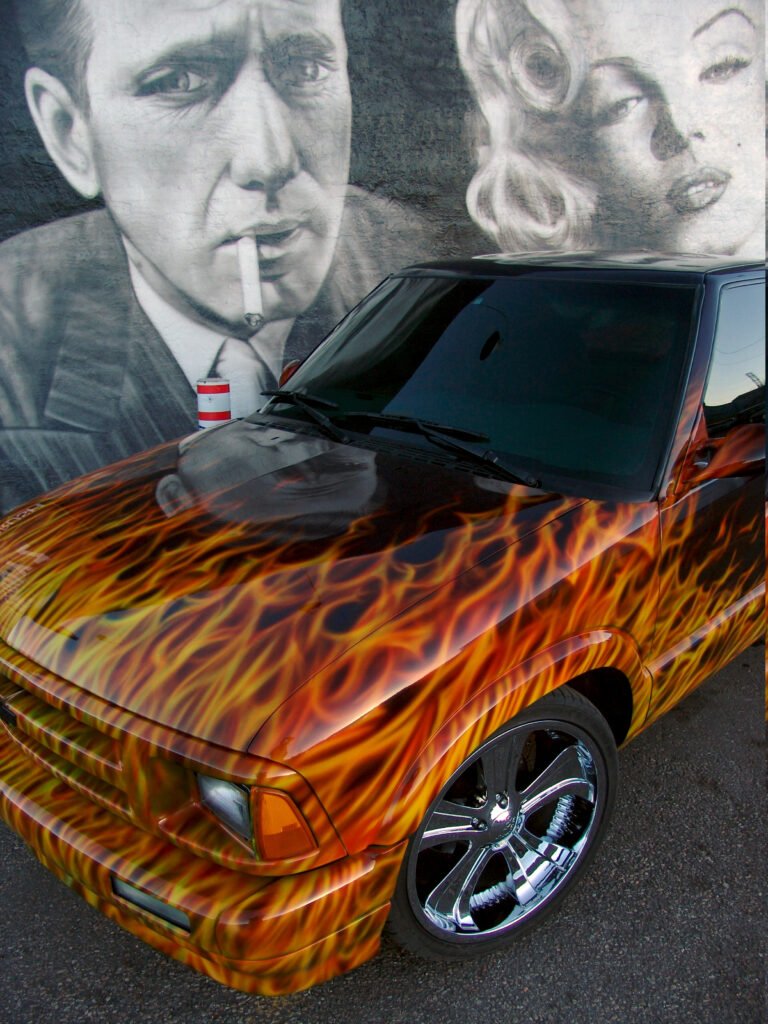
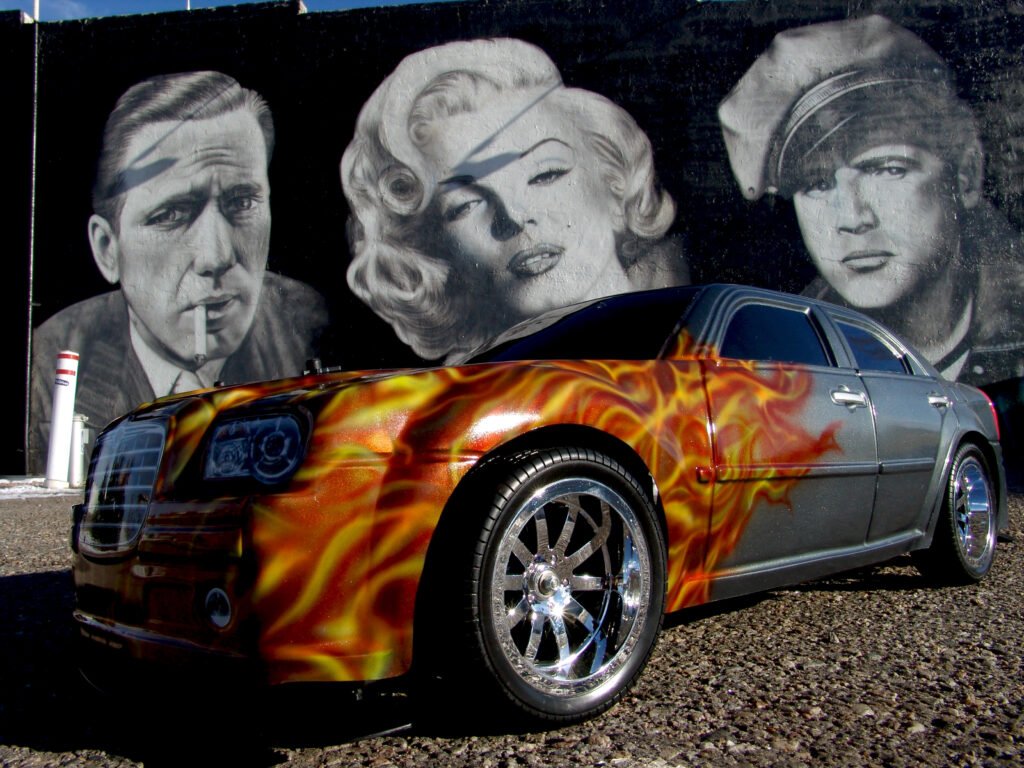
During my airbrush portrait period I also fell in love with painting realistic flames. This is a picture of my wife’s truck. We endearingly called it the ‘firetruck’. I offered the service of painting realistic flames on vehicles and motorcycles.
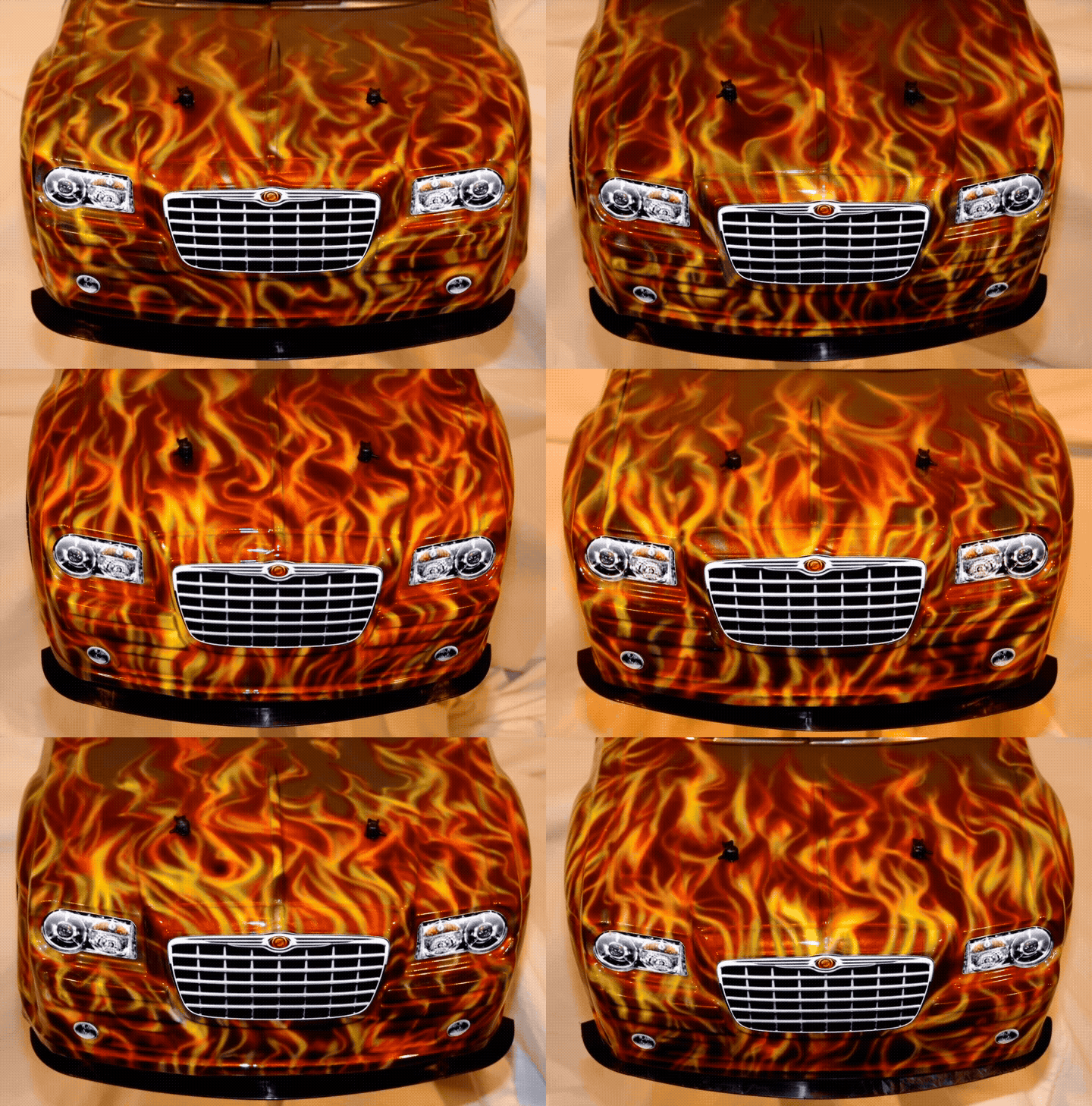
I even painted several 1/5th scale RC cars. Here is a gif showing several styles of flames in order to show my customer what was possible.
This style of paint would work itself onto one of my computer mods too, I will publish that next post.
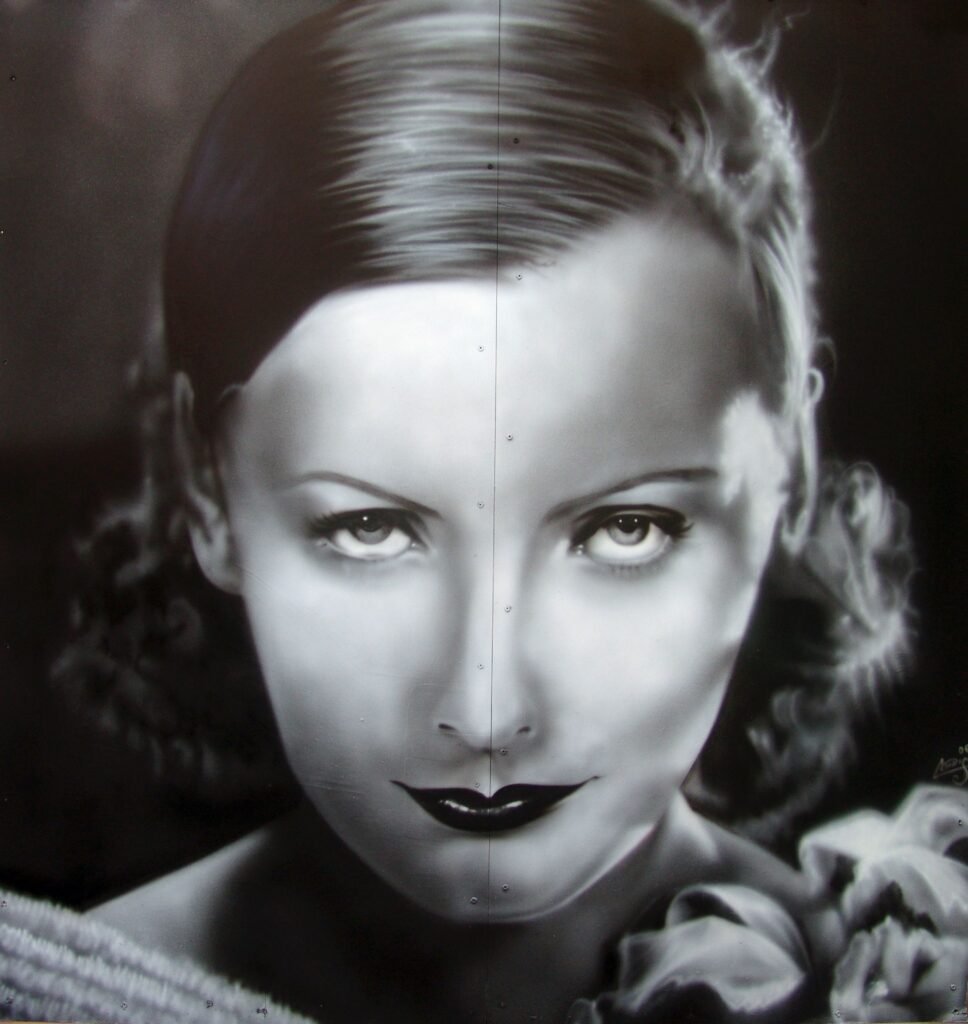
Seems not too long ago I painted these, but I guess it’s been 20 years ago now. Does not seem like it though! This pic of Garbo was taken in 1928.
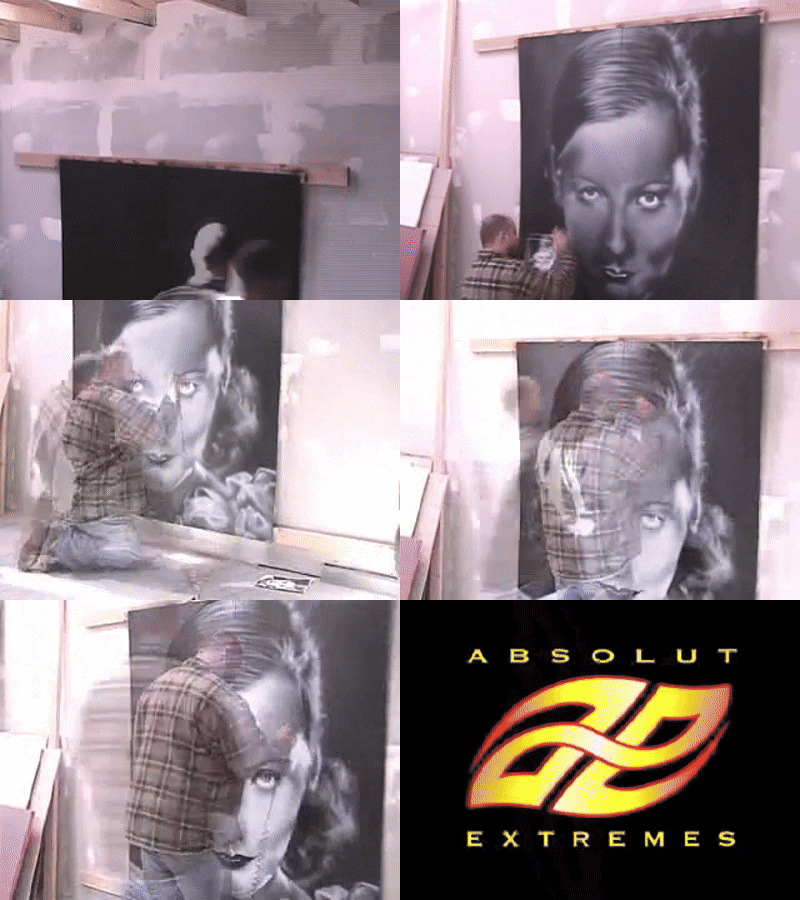
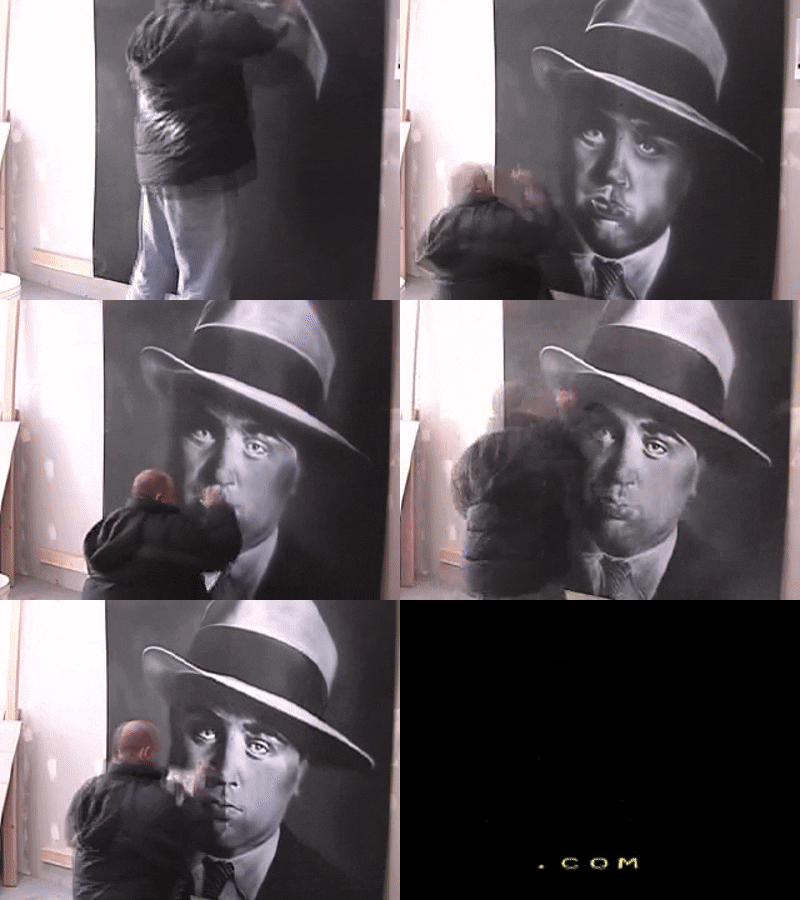
Here is a little step by step gif that shows me in process.
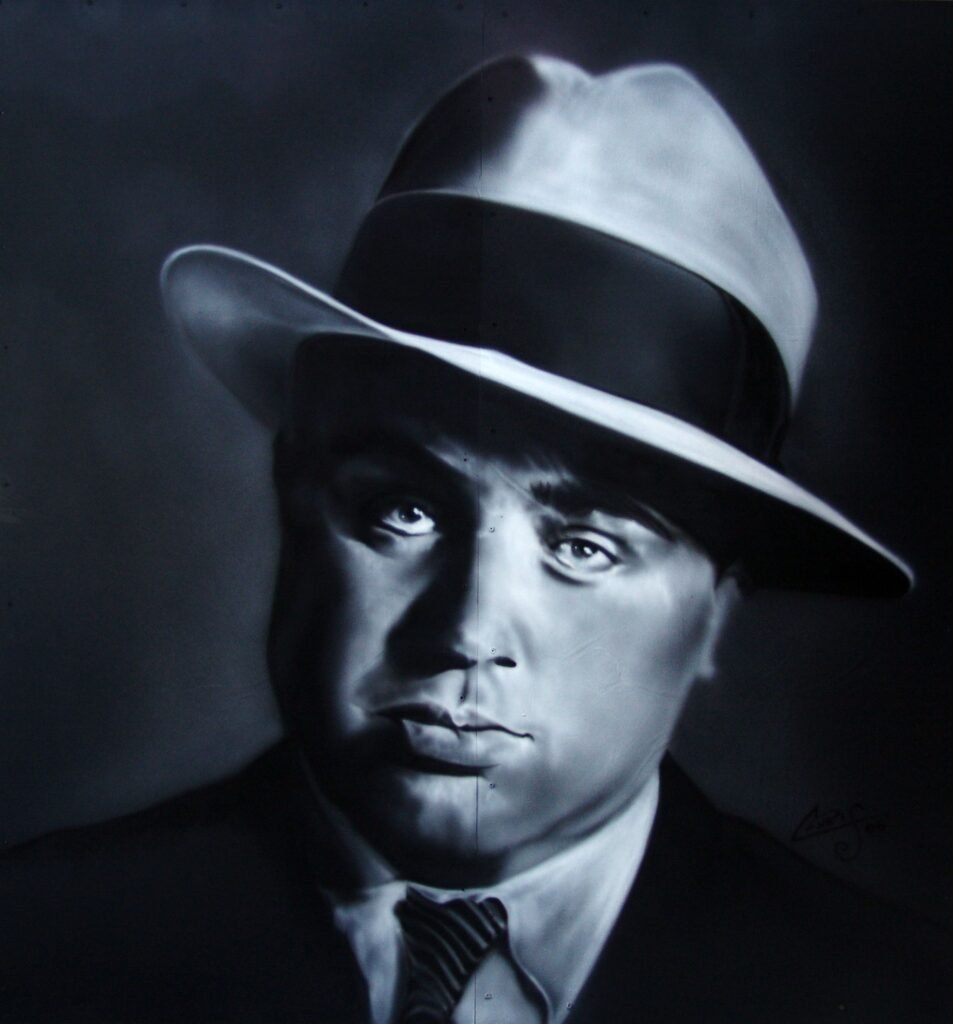
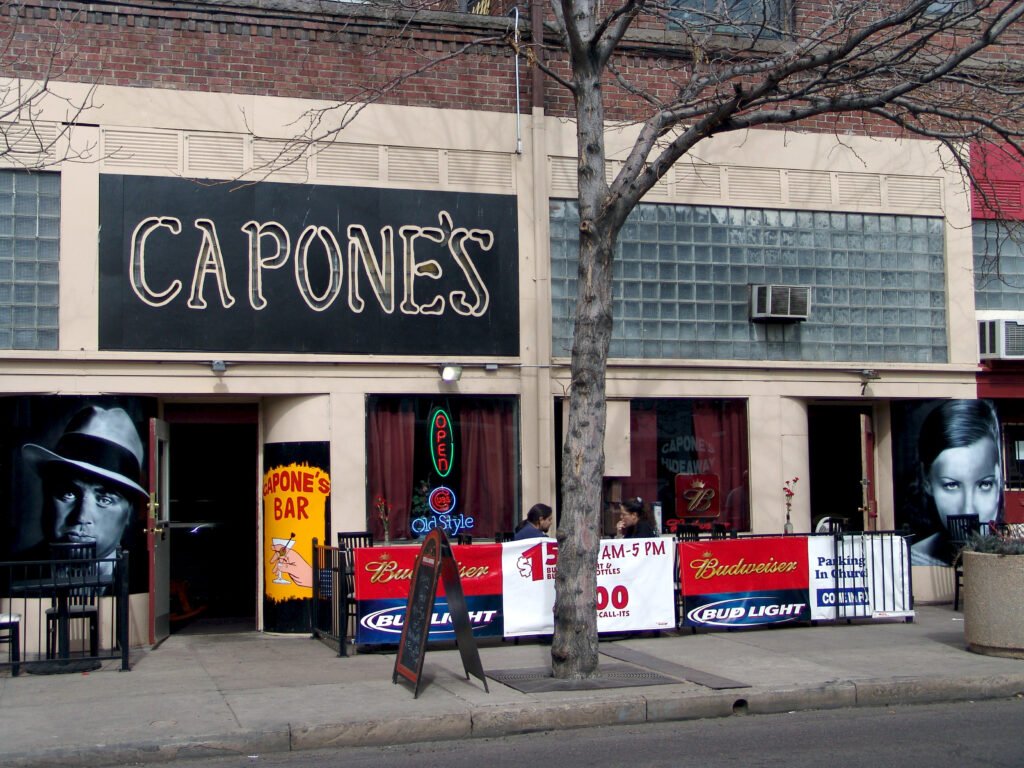
This mugshot of Al was in 1929.
These were painted on two pieces of flexible masonite so it was easier to attach them to the building on a curved surface. These were for the Capone’s restaurant in Denver Colorado. Nothing like remembering the roaring 20’s!
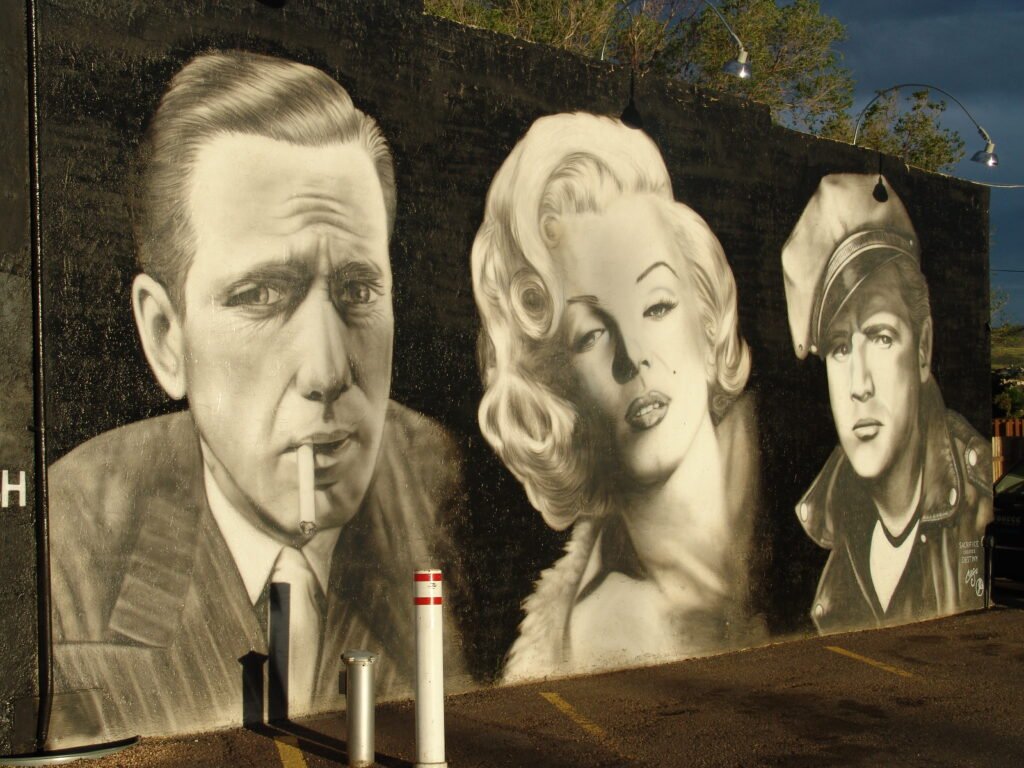
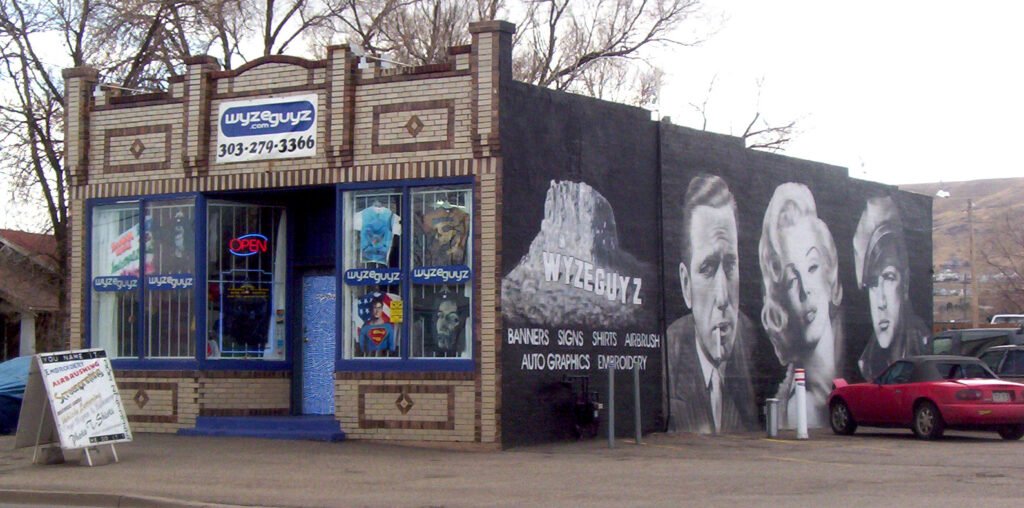
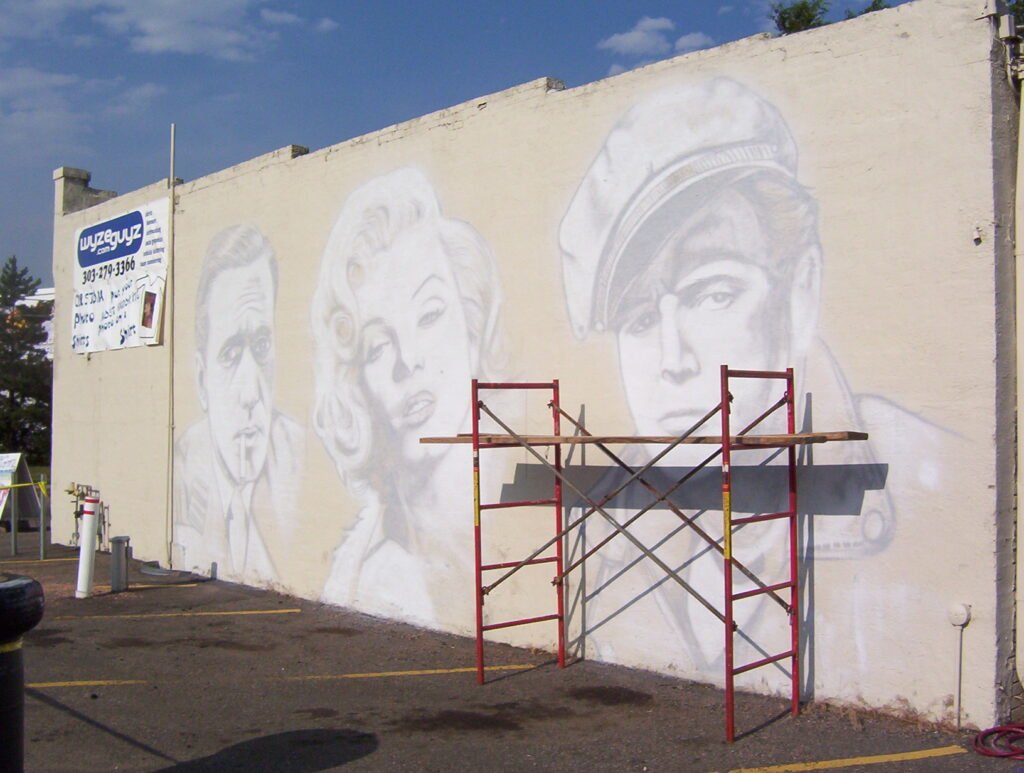
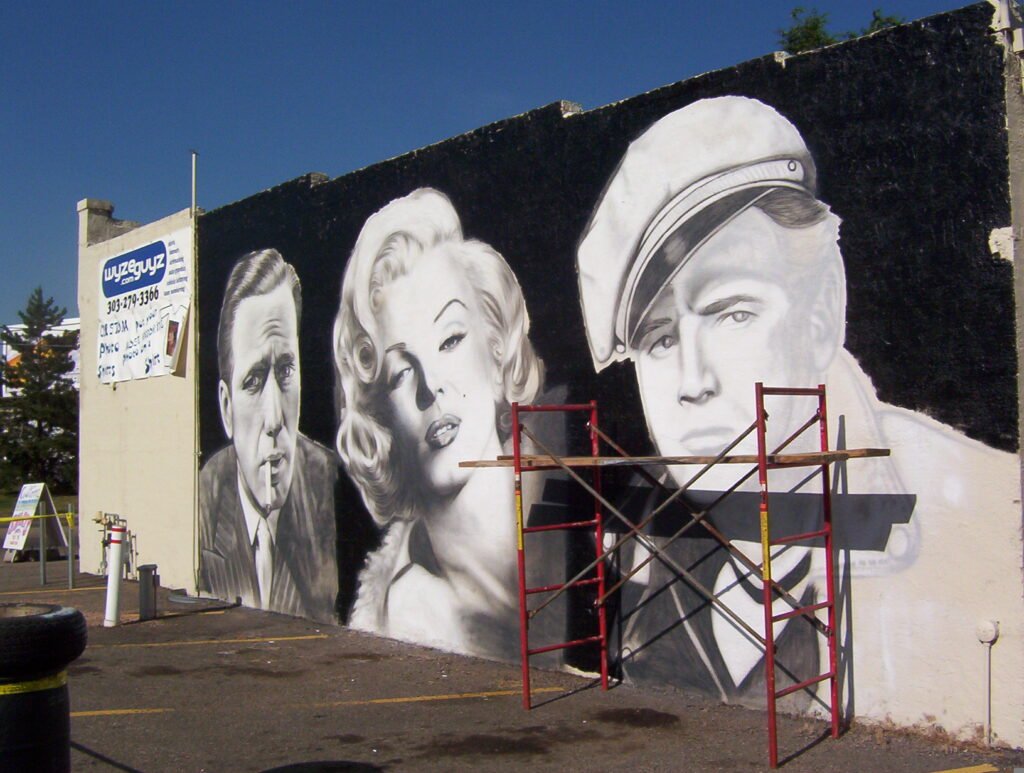
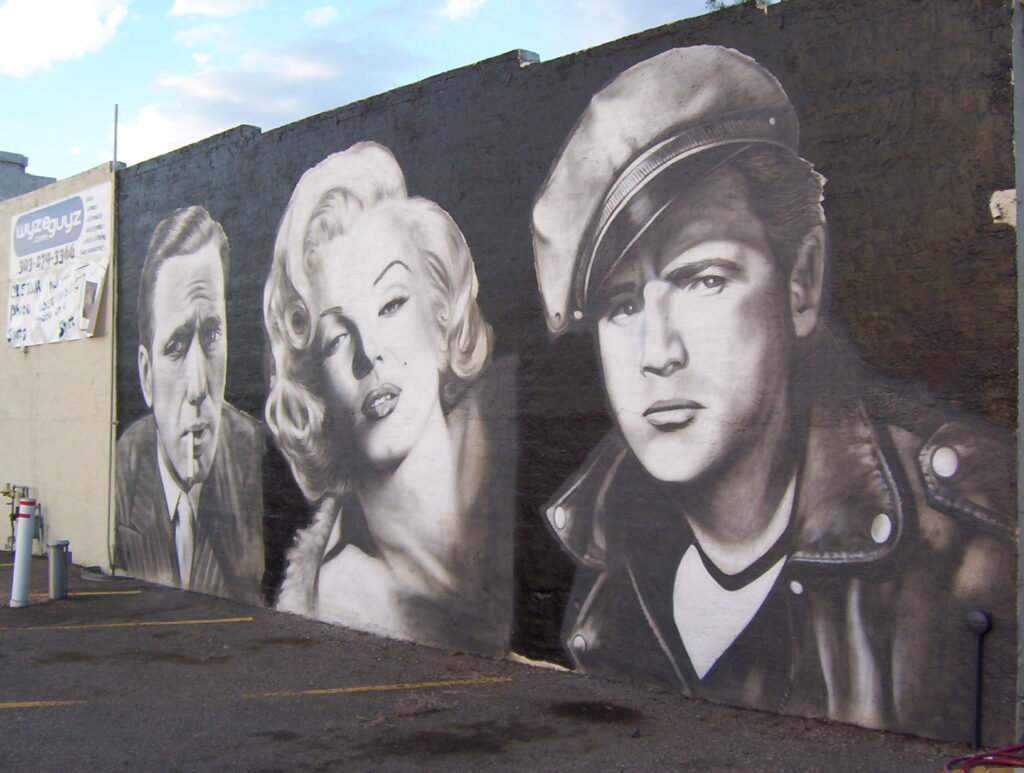
Yes, for the record I am the one who painted the mural at 16350 South Golden Rd. in Golden CO. I finished it July of 2004. AI and Google have not correctly reported it over the years, so I thought I would create a post about it. Make sure to click on the image as I have left a high resolution pic of the completed mural one year after I finished it.
I painted it on the west side of the building that we rented as my art shop. The first panel depicts South Table top with the company name WYZEGUYZ displayed across it like the Hollywood sign in California.
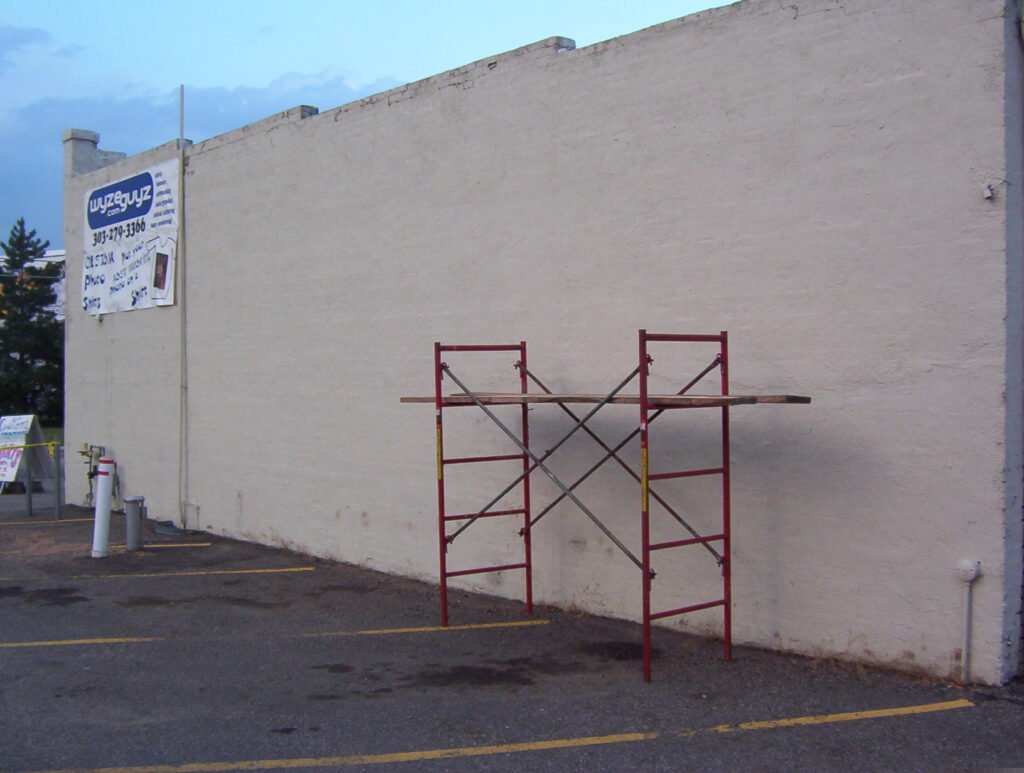
Here is a series of progress pics of the mural. The actual measurements are fourteen feet high by forty feet long. My favorite part of the mural is the highlight on Bogart’s upper lip reflecting the white cigarette. I NAILED that detail!!! Also for scale reference, Marilyn’s lips are three feet wide!
I also would like the general public to know that I specifically painted this mural knowing it would deteriorate over the years and hoped that younger generations would have to figure out who these ‘celebrities’ were in American history. One side effect I had not planned on was how poignant the digital history would be. If you go look up this address in Google Maps and bring up ‘street view’ you can see the evolution of the resolution of Google’s cameras over the years. The first shot is very low resolution, ironically when the mural looked the newest. And now 22 years later the resolution is much better, but the mural continues to deteriorate, like I planned all along. Fun little fact.
I am honored and humbled that the piece has lasted this long without tagging. In my next post I will go over my airbrush portrait collection briefly to satisfy any more interest. Fun to go over memories of the past.
I saw Golden Today posted a very early picture of the building early in its history HERE.
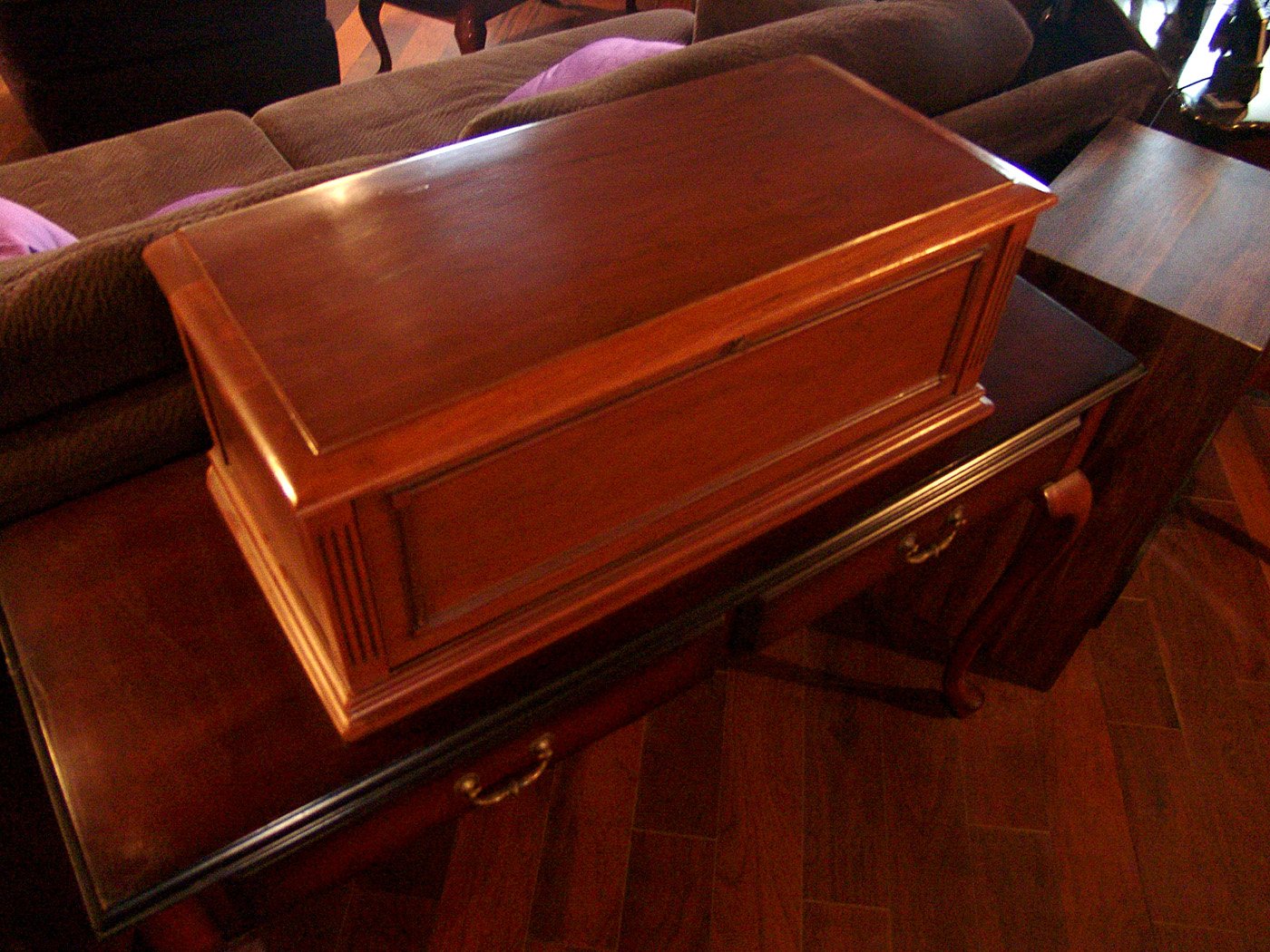
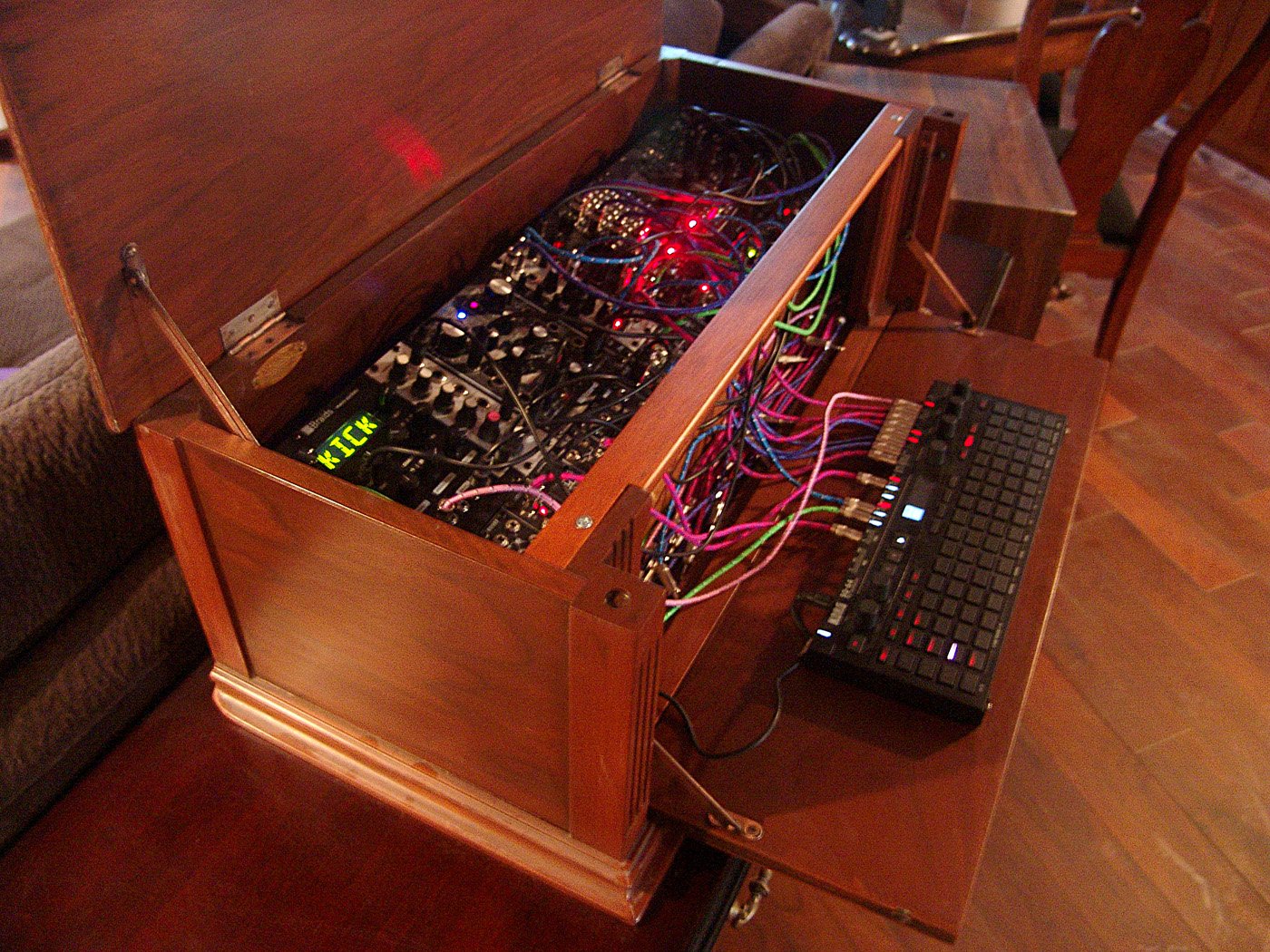
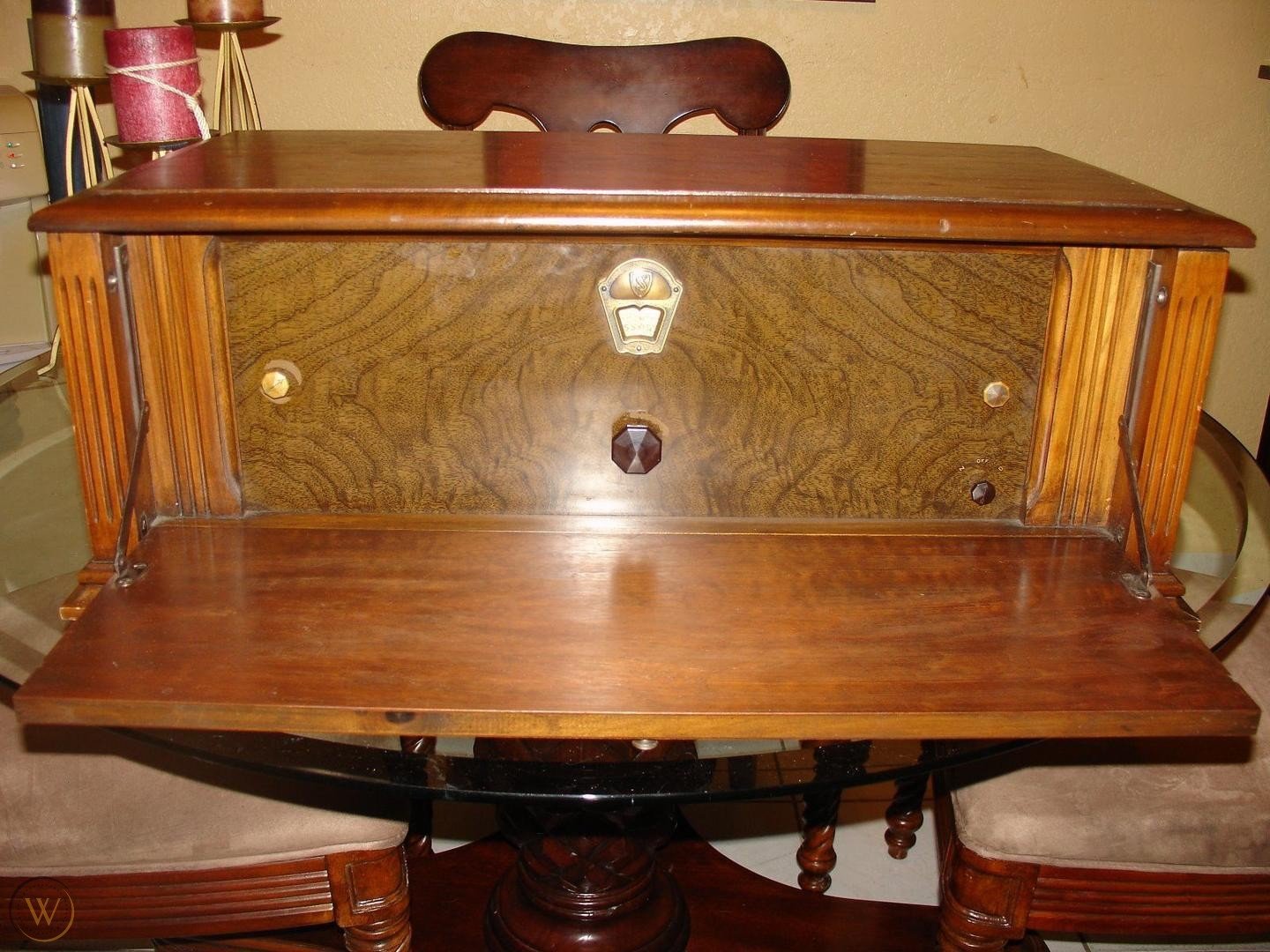
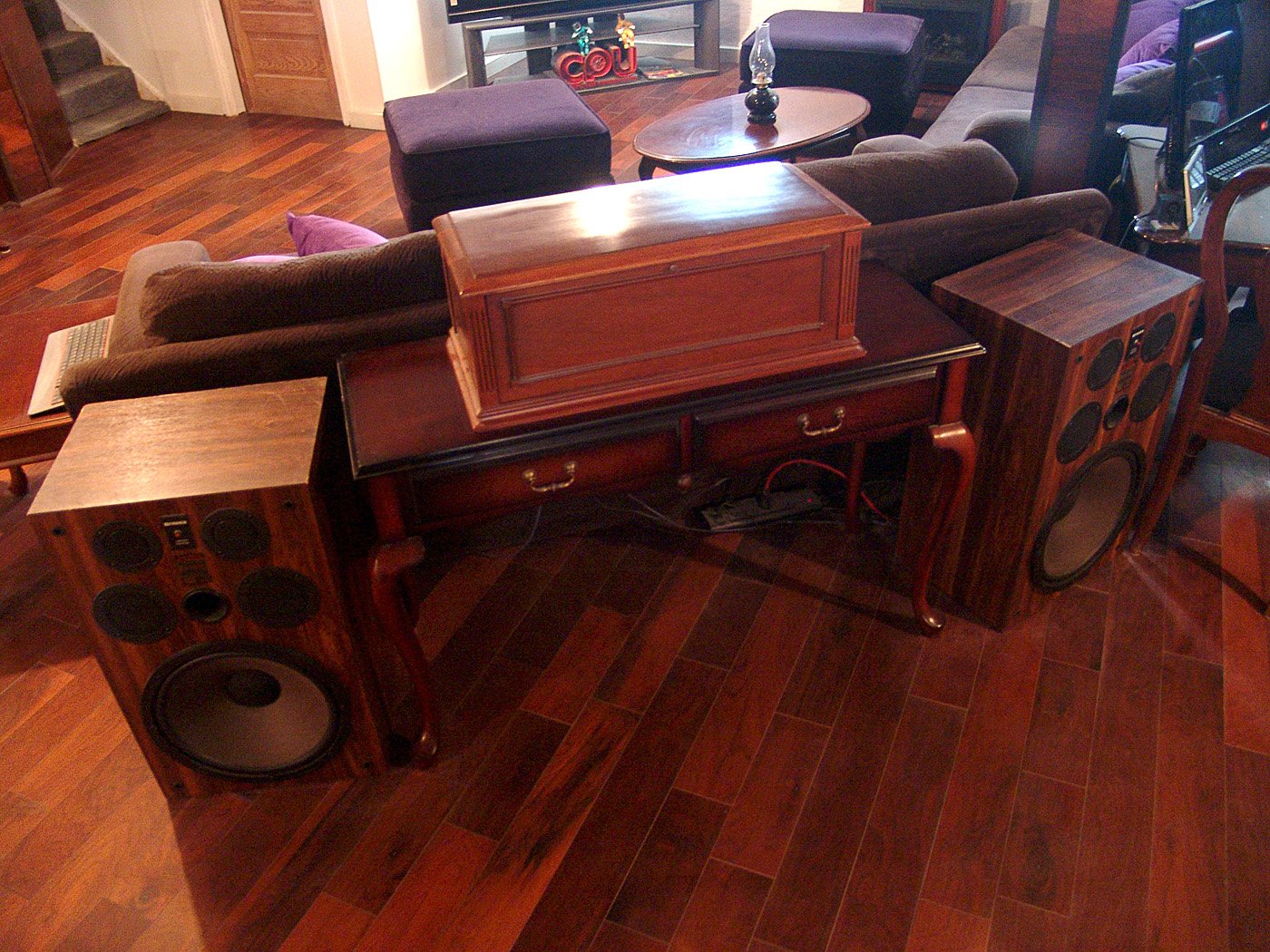
In 1927 Sparks-Withington Co (Sparton) produced this battery powered radio for $188.00. Adjusted for today’s inflation that price is now approximately $3,620.88. Most today would see this as an old relic from the past and dismiss it immediately. My grandmother passed away 10 years ago now and she told me many stories of listening to this radio. She was 8 or 9 years old, as she recalls when she first heard it. This radio manufacturer was a stone’s throw from where she grew up and I have fond memories of playing around the building where Sparton used to manufacture these in southern Michigan. The company has long since vanished, but the building still stands as so does this cabinet.
The box was built of stunning quality hardwoods and all the hinges worked great. Not bad for being almost 100 years old! The original radio had long since been dismantled and used for parts leaving only this very well crafted wooden box.
Here is a pic of the original box.
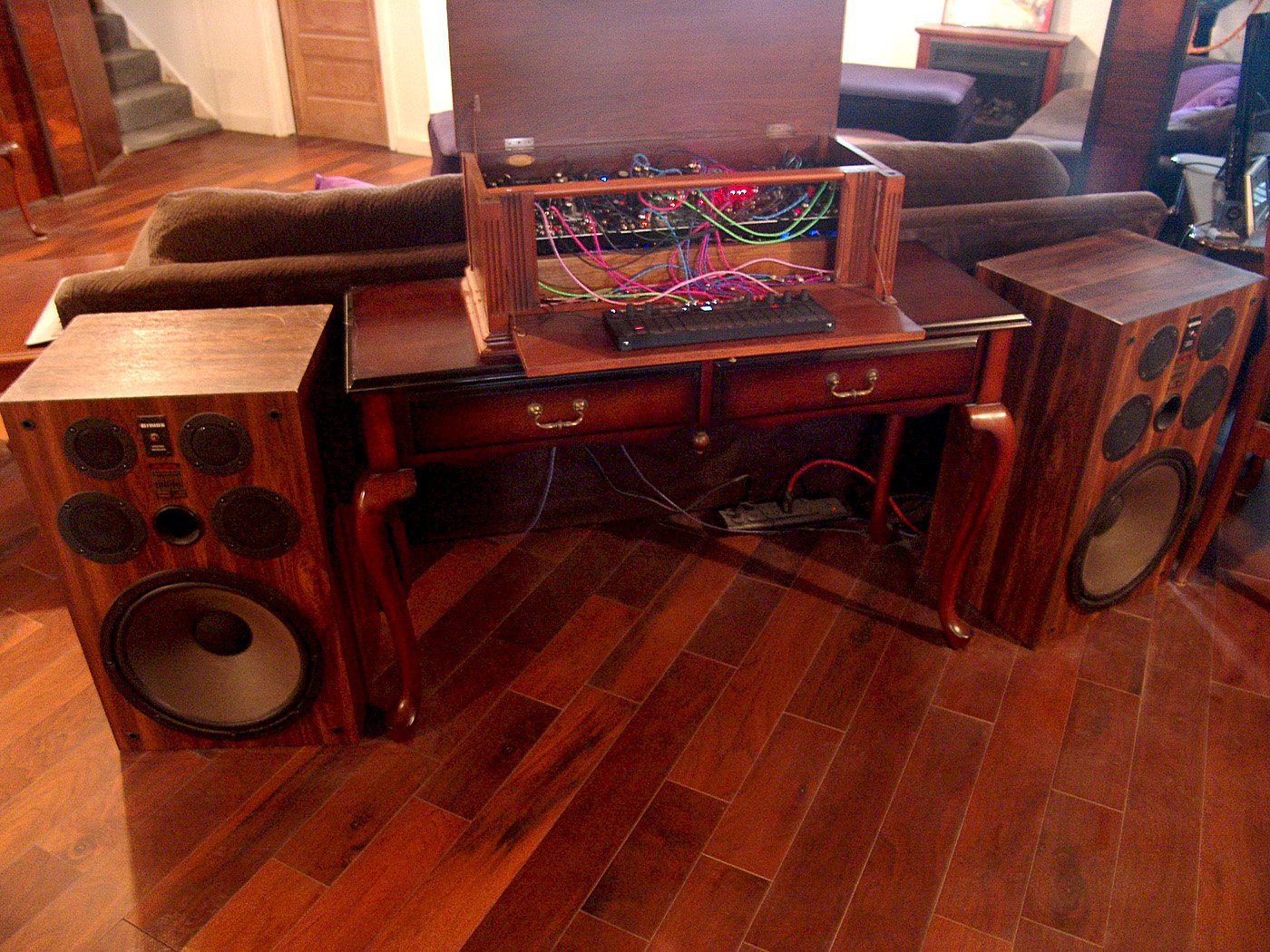
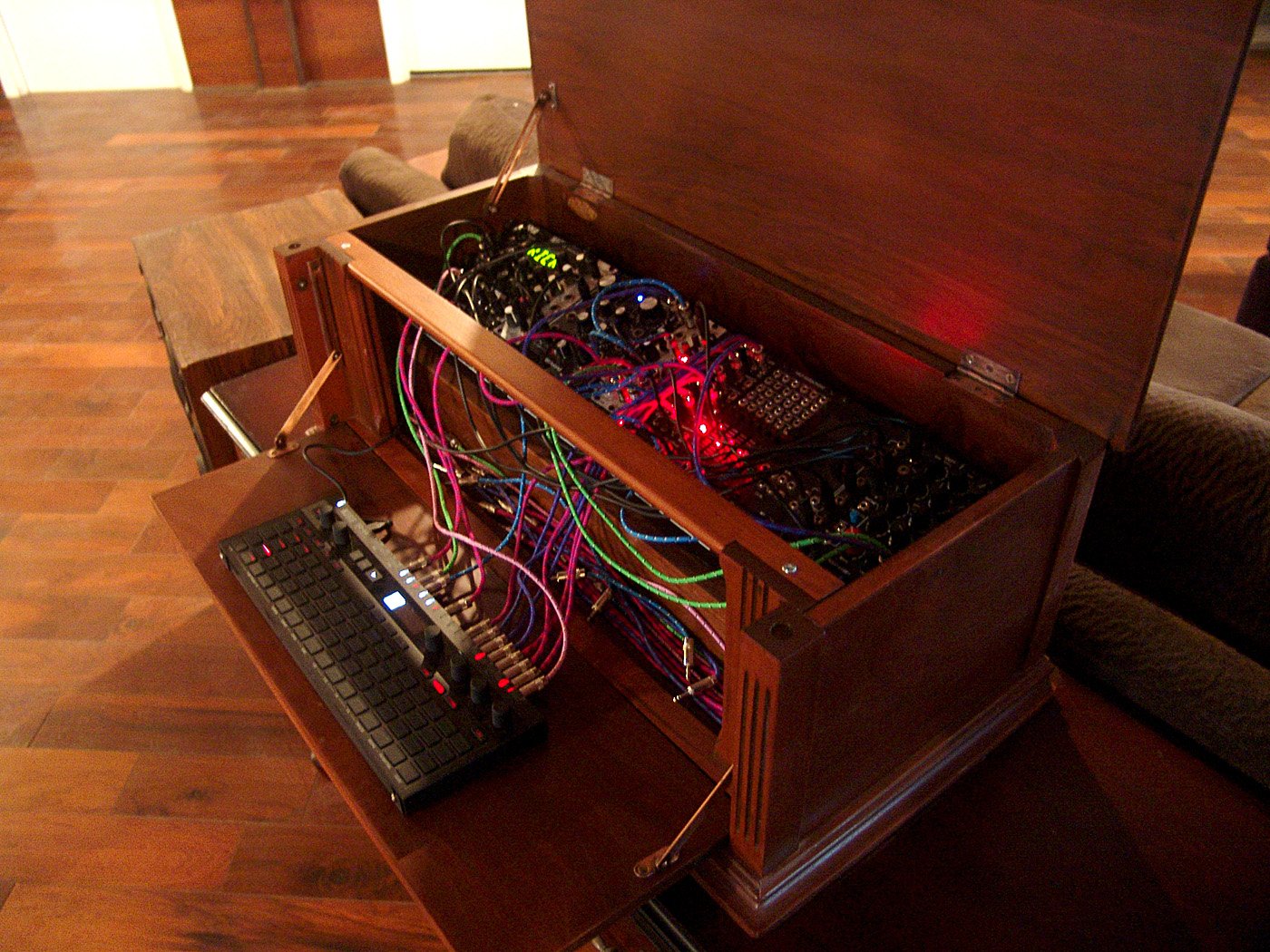
I thought it only fitting to restore this box, changing the purpose only slightly from its original use. I added 127hp of 3U eurorack space and a 1U Pulp Logic row as well as a Korg sequencer with some custom made brackets to attach it to the front door. Added a Bluetooth receiver and small amp to power my old Fisher speakers. There are of course a few of my own custom modules in there too.
Put the refurbished box into the center of the basement where it now can entertain my friends and I today.
There will never again be a time like my Grandmother’s childhood, a hundred years ago, but maybe with a little bit of luck we can hope some of these things can still be used and reused, going well into the future.
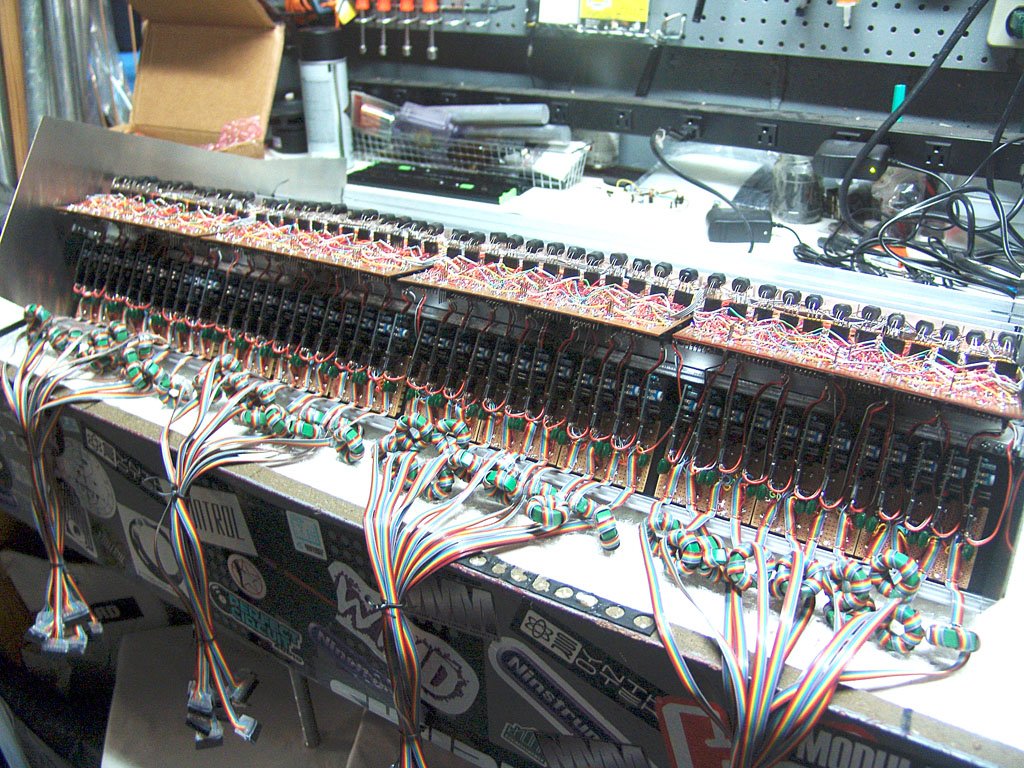
Pushing hard to get through this mixa’ project. Lots of little and big details. Finally finished cutting out all the panels and powdercoating them and screenprinting them. Turning out sharp.
Nice to see the meter bridge turned out just like I wanted it to. I designed it right into the seem to give it a ‘traditional’ mixer look. That section was a bit tricky and required me to spilt the Vector rails laterally. That was fun to do with a routing table.
Rough fitting it into the cabinet where it will rest. I wanted the faders to be illuminated so I would not have to squint to see where they were all at. I now have to move a bunch of euro mixer modules out of my rack to make room for more modules 😀
Rough fitting this beast into its final home was fun. I was within 1/32″ of my spec over 30″ wide, so I am very happy. The more I design, build and create the more I find my tolerances tightening up. It’s a great feeling to slide some thing like this right into place.
So the eagle eyed person would recognize the 48 channel strips, but where’s the rest of it?
Yes, I am designing a couple of different sub-mixers now. The first up will be a Quadraphonic sub-mixer module. I have always dreamed about having a dedicated quadraphonic mixer, now I will build it right into my eurorack. Having built these 48 channels separately I can use the row right in front of them for a custom set of sub-mixers and crossfaders!
Lots more work, but now it really is getting fun as I have ‘most’ of the really boring wiring finished and tested. Turning out to be the best Christmas present I have ever received. More to come…
Folktek modules/instruments are unique in their creation from other current eurorack design philosophies. There are strong design elements that are deliberate and there also is a sense of general functionality, but as you use them, your mind wanders easily and you can coax the ‘engineer’ out, to add to and possibly ‘re-design’ the work flow. I only have worked with Folktek eurorack modules so far, but I am always interested with what they come up with.
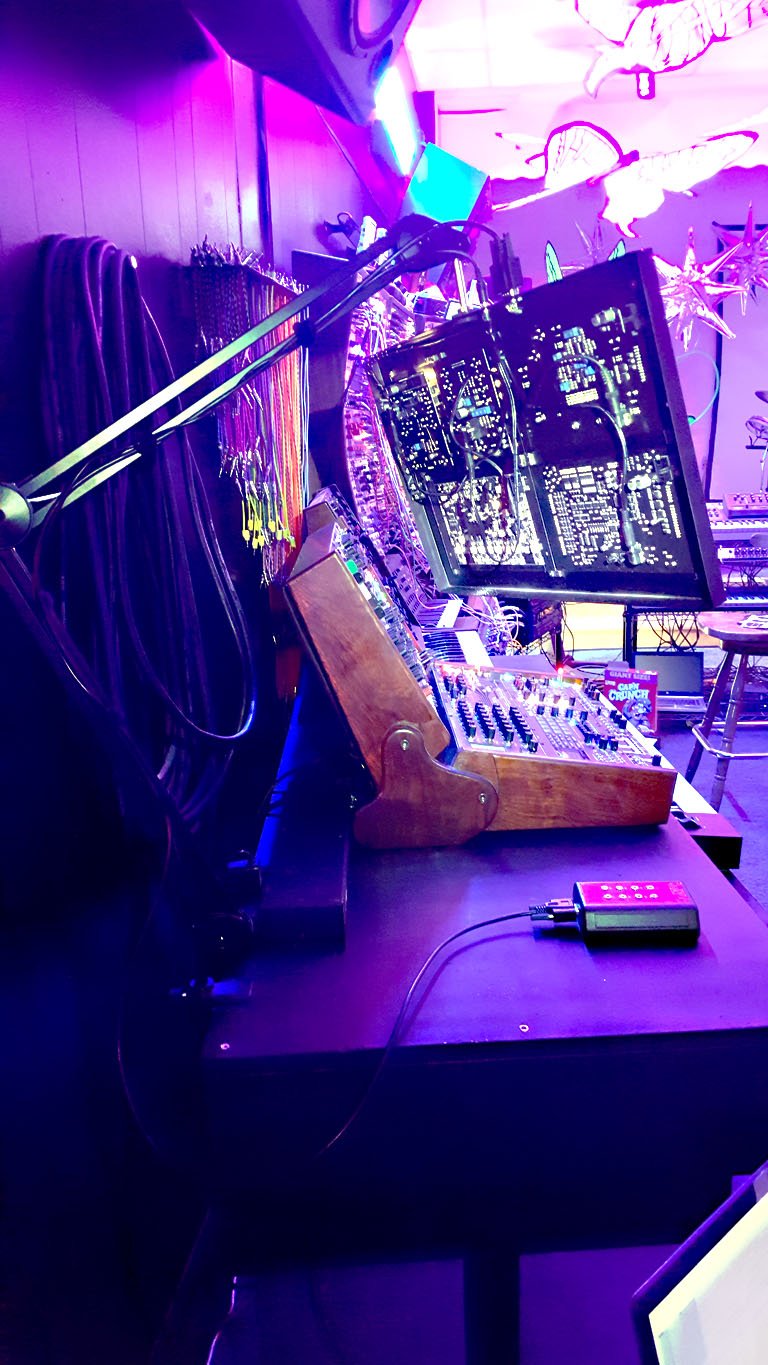
My initial jump into the Folktek world were acquiring the Conduit and Matter modules. There is now a second version of Matter, but these are the first gen versions. I used the pair in my larger system, for a while, but I found I did not integrate them into my other euro modules as much. The little headers and jumper wires are more familiar territory to bread boards and test benches. Then I started to use the Mescaline system and decided it would be cool to combine those first gen modules into one dedicated system.
Folktek are made with PCB’s as both the front panels and secondary panels. This makes them very light weight. With the popularity of podcasters, the ‘floating’ microphone stands are now pretty cheap. So I fabricated a light weight .050 aluminum bracket. I added an 8 jack breakout box with the corresponding jacks on the frame, allowing signal I/O. The arm is rated for 4-5 lbs and it responds well to moving it around using two hands.
With this flexibility I now find it easier to tweak the pots on the back of the modules. This is something Folktek encourages. Again, this is a different approach from most eurorack module manufacturers.
I have found this approach refreshing and unique and allows me to easily jump into the Folktek world. Also as an arm chair engineer, I can test out new components immediately!!! Just don’t forget your small breadboards when you feel the need to make large changes to your patch. They come in very handy.
If there is one area in Eurorack where I find YOU want to really have exactly what YOU want, it’s the mixer. We all seem to need slightly different things. The trick is, you really can’t have EVERYTHING you want. You could, but the mixer component count would be crazy. Heat, noise floor issues, ground plane tweaking and half a dozen other factors have to be considered. So I decided to build myself a custom compact-ish 48 channel mixer with just what I need, in order to keep the component count low, and to keep the troubleshooting down to a minimum. On to prototyping…
Were you one who’s entire life came to a halt in mid March, or were you able to keep most of your life on its semi-standard course?
Well, my wife and I found ourselves completely stopped in our tracks. What to do with all of this free time?
I started this project in November 2019 and didn’t expect to get this far for at least another year. And this has been a VERY challenging year so far.
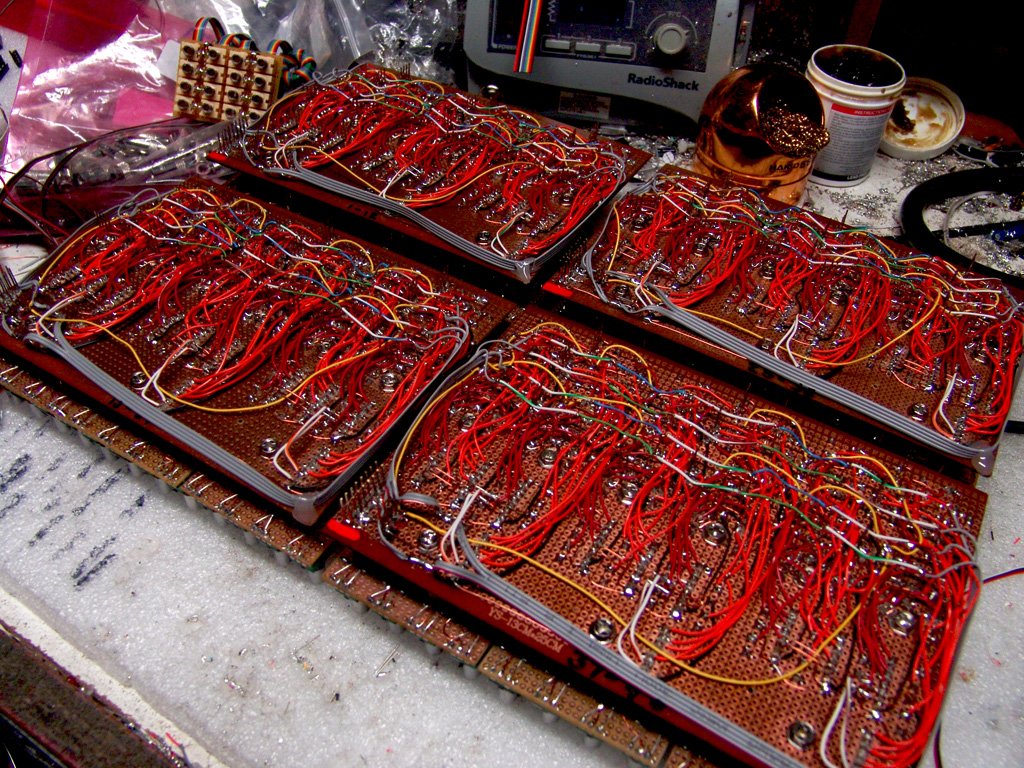
Two solid months of work in the above pic! Anyone for some fresh noodles? I have never done this much point to point soldering in my whole life! So? Why use PTP for this?? you ask.
The empress Reverb is one of the most expressive reverbs, IMHO 😀 So you know where I headed next? Yes, it’s getting to be a repetitive scenario for me, isn’t it? Original Manufacturer’s site is located HERE.
All circuitry is custom to each conversion and calibrated accordingly. There can be differences between pedals I find. Very unusual for a digital pedal. Conversions can be like that. Each one is unique and satisfying in its own way 😀